
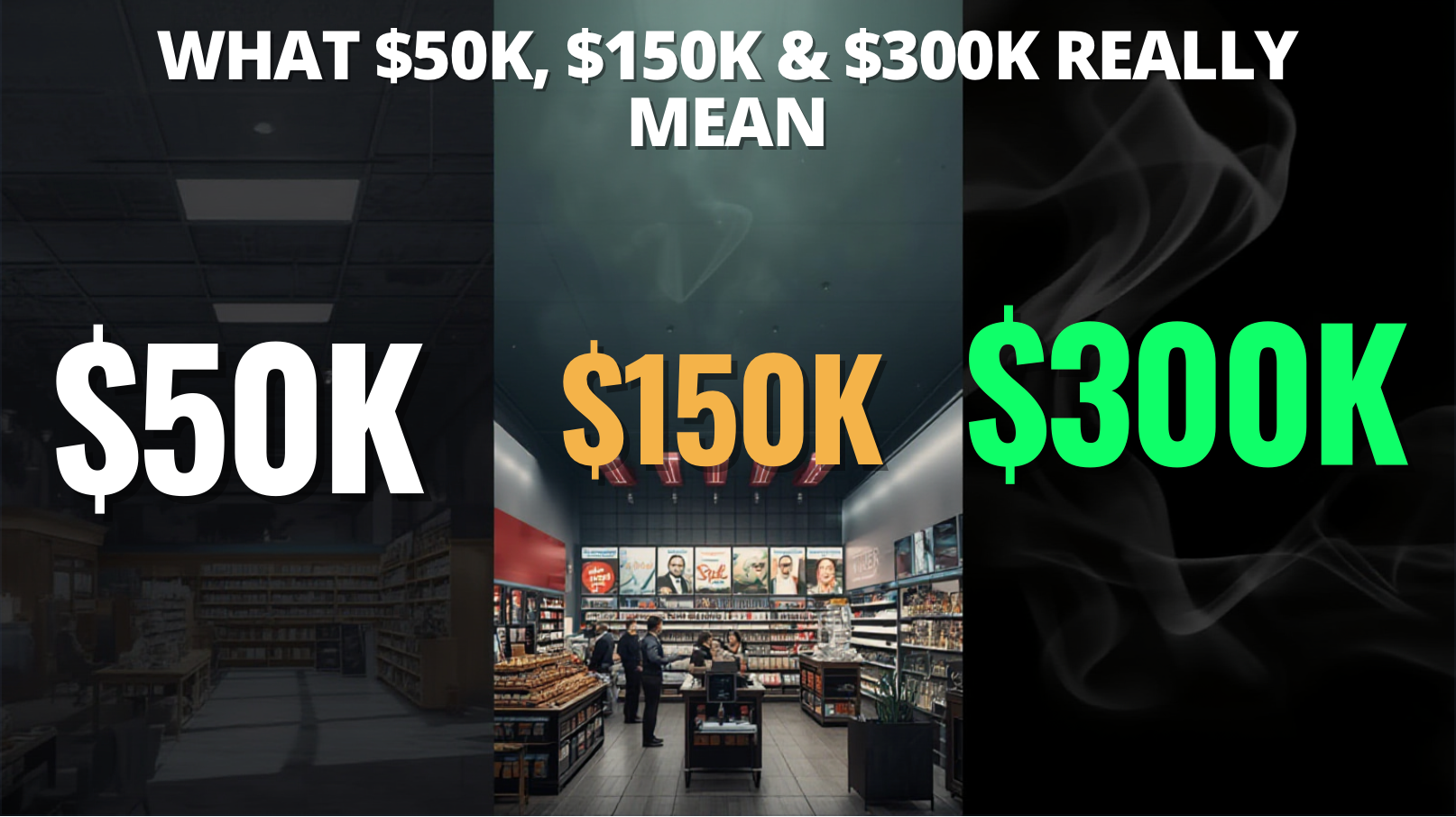
One of the most common questions I get sounds simple on the surface:
“How much money do I need to open a smoke shop?”
What people are really asking is something else entirely.
They’re asking:
-
How safe am I?
-
How many mistakes can I survive?
-
How stressed am I going to be?
-
And how much room do I have to breathe?
Because in this business, money doesn’t determine success —
it determines how expensive your learning curve is.
it determines how expensive your learning curve is.
I’ve seen shops open with $50,000 and survive.
I’ve seen shops open with $300,000 and fail.
I’ve seen shops open with $300,000 and fail.
The difference was never the number.
It was how the money was used.
It was how the money was used.
$50,000: The Danger Zone (But Not a Death Sentence)
Let’s start with the tightest scenario.
Opening a smoke shop with around $50K is possible — but it leaves no room for ego.
At this level, every dollar has a job.
Every mistake shows up fast.
Every bad buy hurts immediately.
Every mistake shows up fast.
Every bad buy hurts immediately.
What usually goes wrong here isn’t effort — it’s overreach.
People with $50K try to open the store they want, not the store they can actually support.
They:
-
Overbuild the space
-
Overbuy inventory
-
Chase too many categories
-
Try to look “established” on day one
That’s how panic sets in.
At this budget level, survival depends on:
-
A smaller footprint
-
Fast-moving, proven inventory
-
Conservative reorders
-
Cash left untouched for problems
This is where guessing gets very expensive, very quickly. One wrong inventory decision can lock up cash you don’t have time to wait on.
This is also where many new owners realize — often too late — that learning by trial and error costs more when your margin for error is thin. Structure matters more than ambition at this level.
$150,000: The Sweet Spot (If You Don’t Waste It)
This is where things get interesting.
$150K gives you breathing room — but it also gives you more ways to screw things up.
At this level, the biggest risk isn’t running out of money immediately.
It’s slowly bleeding without noticing.
It’s slowly bleeding without noticing.
People feel comfortable, so they:
-
Buy wider instead of deeper
-
Experiment too much
-
Carry inconsistent brands
-
Add vendors instead of simplifying
The store looks good.
Sales happen.
But cash still feels tight.
Sales happen.
But cash still feels tight.
Why?
Because money is scattered across too many SKUs that don’t all perform.
This is where disciplined operators separate themselves.
Smart owners at this level:
-
Stock fewer categories more intentionally
-
Focus on inventory that reorders predictably
-
Simplify sourcing instead of complicating it
-
Start thinking about systems, not just sales
They use the extra capital to reduce stress, not inflate the business.
This is also the point where many owners realize they don’t need more ideas — they need clearer frameworks. That’s often when they stop piecing information together randomly and start looking for proven ways to operate and source consistently.
$300,000: The Illusion of Safety
This is the one that surprises people.
More money does not equal less risk.
It just changes the type of risk.
With $300K, the temptation is to build big:
-
Large store
-
Heavy buildout
-
Deep inventory across every category
-
More staff early
The problem is that scale amplifies mistakes.
If your inventory strategy is messy at $50K, it’s catastrophic at $300K.
If your sourcing is inconsistent, the losses are bigger.
If your systems are weak, the stress multiplies.
If your sourcing is inconsistent, the losses are bigger.
If your systems are weak, the stress multiplies.
At this level, the question shouldn’t be:
“What can I afford?”
“What can I afford?”
It should be:
“What can I control?”
“What can I control?”
The operators who succeed with larger budgets:
-
Treat inventory like frozen cash, not toys
-
Standardize early
-
Track movement relentlessly
-
Build the business to run without heroics
This is also the level where the cost of guessing becomes unacceptable. One wrong direction can cost tens of thousands instead of thousands. That’s why experienced owners tighten structure before expanding, not after.
The Common Mistake Across All Budgets
Here’s the universal problem.
People match their spending to their confidence, not their experience.
Confidence feels good.
Experience is expensive.
Experience is expensive.
Regardless of budget, the businesses that survive share the same traits:
-
Predictable inventory flow
-
Consistent sourcing
-
Clear reorder logic
-
Fewer emotional decisions
Money doesn’t create those things.
Discipline does.
Discipline does.
Why Capital Should Buy You Time, Not Pressure
Your starting budget should do one thing above all else:
Give you time to learn without panic.
Time to:
-
See what actually sells
-
Kill what doesn’t
-
Tighten systems
-
Build confidence through clarity
When money is used to chase appearance instead of control, time disappears fast.
That’s when owners feel forced into bad decisions — discounts, overbuying, or trend chasing — just to keep momentum going.
The Smarter Way to Think About Budget
Instead of asking:
“How much do I need to open?”
“How much do I need to open?”
Ask:
-
How many bad decisions can I survive?
-
How long can I operate if sales slow?
-
How quickly can I recover from a mistake?
Those answers matter more than the dollar amount.
And they’re why many operators eventually realize that having access to proven sourcing and operational structure reduces risk more than having extra cash. Money disappears. Systems stay.
Final Thought
$50K, $150K, or $300K can all work —
or all fail.
or all fail.
The budget doesn’t decide your outcome.
Your allocation does.
Your allocation does.
The smoke shop business doesn’t punish people for starting small.
It punishes people for starting sloppy.
It punishes people for starting sloppy.
The more deliberate you are early, the less dramatic everything feels later.
And calm businesses tend to last.